You cannot improve that what you cannot measure.
1:27


共识很明确:高质量的心肺复苏挽救生命,1,2but when seconds and millimeters can be the difference, even seasoned professionals can have difficulty achieving correct compressions on look and feel alone.
Fortunately, multiple studies3,4have shown that real-time feedback can improve the quality of compressions provided.As the Resuscitation Academy's Mike Helbock states below, "You cannot improve that what you cannot measure," meaning if your goal is to optimize performance, performance feedback becomes a necessity.
五位专家分享了他们对使用实时反馈设备在改善心脏骤停生存方面的作用的看法。
很难让医疗保健提供商进行指南压缩,您确实需要某种反馈设备来知道您的费率的速度或深度的深度。At our institution, we’re starting to use more and more of these devices, because we know that healthcare providers can’t do Guidelines CPR quality not because they can’t, but because they just don’t know what 2 inches of depth is without some sort of feedback.
我们所有人都应该衡量我们在CPR中的表现。…我们有一个范围需要介于两者之间,以优化患者的结果。我们需要能够实时衡量这一点,并获得实时反馈,并衡量我们在自己的社区中的成果,并知道我们的绩效是什么,以便我们可以识别问题,优化护理并确定问题,并确定问题和改变它们。
它使我们保持诚实,是底线。…它告诉我们我们的压缩是否太深了,或者我们的时机是否停止或类似的东西,因此我们一直在努力使用该反馈。您培训人们如何做最好的心肺复苏术,并使用反馈设备进行操作至关重要,因为它为您提供了如何做到完美CPR的良好模型。
Monitoring and feedback for CPR, I think in a way, that’s the most important thing for EMS providers, for in-hospital providers. … Max Harry Weil, who invented ICU, said, ‘Not using CPR feedback during a code is like a pilot not using GPS while they’re flying a plane.’” … For healthcare providers, I think it’s absolutely essential that we have specific feedback on quality of CPR. That’s extremely important in training.
我们确实坚信能够在接受培训时向个人提供反馈。能够为他们提供有关其压缩率和深度的直接反馈,在教育过程中确实是不可或缺的。它可以帮助人们真正了解他们的赤字在哪里以及他们可以改善的方面。这是非常重要的事情,希望能够在以后的后续教育迭代中整合。

In this article, we share five reasons why real-time feedback can help providers and their organizations go from good to great in delivering CPR.
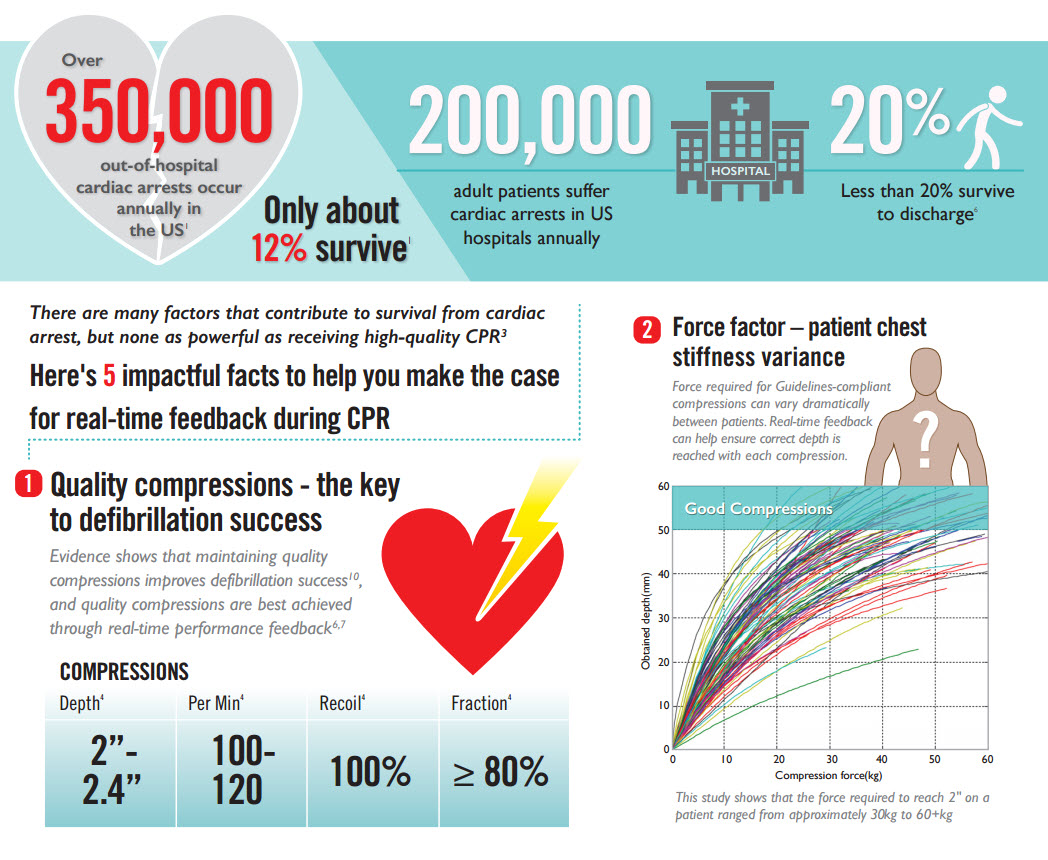
This infographic provides five impactful facts to help you make the case for implementing real-time feedback during CPR.
The five facts cover:
1)质量压缩和除颤成功
2) Patient chest stiffness variance
3)啊哈推荐
4) What's better, visual or auditory feedback?
5)研究结果:反馈与盲目CPR的CPR