Skip to content
Open navigation
_BER5065.jpg _BER5065.jpg

One Minute Can Mean a Lifetime

A Tale of Two Births:

以下都是保监会的真实故事ulated widely in the media. Both involved emergencies in the first moments of a child’s life…

In the first story, the attending staff had trained aggressively to identify and manage labor and delivery emergencies. Upon diagnosing the immediacy of the risk factors present, the staff carried out a well-planned and rehearsed effort that avoided harm to the child. To the joy of the family, the birth was a resounding success.

At a nearby facility a similar emergency occurred, but a different story was playing out. How the circumstances were diagnosed and addressed led to emergency interventions that proved fatal to the child and resulted in a $10.2 million award to the mother.

Worldwide each year, an estimated 814,000 neonatal deaths are related to intrapartum hypoxic events (i.e. “birth asphyxia”) in full-term infants.1Of those that survive, many are left with neurological impairments.2

当婴儿出生时,他或她应该在“金分钟”内开始呼吸,这是他们在子宫外的头60秒。大多数婴儿的确开始呼吸。但是,全球1000万婴儿将需要帮助。3Approximately 10% of newborns who do not breathe on their own will respond to drying, warming, clearing of the airways, and stimulation. And, 1% of non-breathing babies will need advanced methods of resuscitation, such as chest compressions and medication.4

To the family, 1% means everything. That 1% stands in the way of the child’s survival, and increases the chance of brain damage even if he or she does survive. The mother who trusts that she will receive the best possible care expects that her providers have been fully prepared for the 1% risk.

一分钟:太短了,无法做什么?

The “Golden Minute” refers to the first 60 seconds of an infant’s life. Within these limited seconds, the infant should begin breathing on his or her own, or interventions must be started.
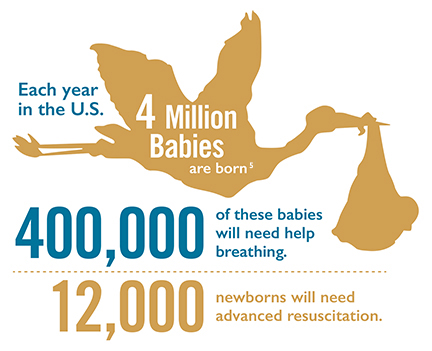
美国每年大约有400万婴儿出生。6It is estimated that 400,000 of these babies will need help breathing and/or positive-pressure ventilations to successfully transition to extra-uterine life. And, as many as 12,000 infants will need advanced resuscitation with chest compressions and cardiac medications.7

在每种情况下,为治疗婴儿采取的步骤必须精确,及时

新生儿死亡的近一半发生在出生后的头24小时。8

Perinatal asphyxia and extreme prematurity are two pregnancy complications that can necessitate complex resuscitation; however, only 60% of asphyxiated newborns can be predicted antepartum.9The remaining newborns are not identified until the “Golden Minute,” which is why it is critical to prepare.

Why the Neonatal Resuscitation Program® (NRP®) Matters

Due to the frequent need for resuscitation at birth, it is critical to have evidence-based care guidelines and to train for effective neonatal resuscitation.

为了确保医疗保健提供者对新生儿复苏的进步保持最新状态,美国心脏协会(AHA)和美国儿科学会(AAP)共同制定了美国的新生儿治疗指南。由美国儿科学会开发的新生儿复苏程序®(NRP®)翻译AAP/AHA紧急心血管护理和新生儿复苏的指南进入教育课程。

The curriculum developed by the AAP includes: eSim, skills practice, online exam, and simulation/debriefing. The blended learning approach helps to prepare healthcare professionals to facilitate有效的基于团队的护理

预期,充分的准备,准确的评估和及时的支持开始,对于成功的新生儿至关重要
resuscitation.10

Some of the most common reasons for failed neonatal resuscitation include:11

  • 未能在出生后不久发现复苏的需求
  • 出生后,未能拥有合格的,经验丰富的医疗专业人员,危险因素增加
  • 团队合作和沟通中的细分
  • Improper neonatal resuscitation techniques

The NRP curriculum helps to increase a care team’s confidence and improve each member’s resuscitation and stabilization skills. Moreover, the curriculum specifically addresses communication and the decision-making processes that are essential in the first—and most important—60 seconds of a newborn’s life.

Recreating the Miracle of Birth

模拟在学习NRP中起着至关重要的作用。模拟增强了技能和知识整合;但是,更重要的是,它引入了人为因素,并将重点放在病人的情况下。

Team communications, interactions with the parents, and the inevitable feeling of uneasiness when a newborn is in distress can all be recreated during a simulation, lessening the stress level when faced with a critically ill newborn.

Simulation training also aids in the prevention of medical errors. Simulation training addresses preventable errors with continual systematic training, performance assessment, and refinement of practice as a team.13

One study found that in situ simulation training, taking place in a real clinical environment, helped to significantly decrease the number of hazardous events during a neonatal resuscitation.14另一项研究发现,在模拟训练后,护士挑战肾上腺素剂量不正确的可能性几乎高40%。15

经过模拟培训,护理提供者可能会看到临床决策,技能提高和自信心的提高,在新生儿复苏期间所有这些都至关重要。

一个快乐的开始

A skilled, confident, and cohesive care team can make all the difference in the first minute of a baby’s life. With neonatal resuscitation training, healthcare professionals are better equipped to recognize a newborn in distress and begin treatment within 60 seconds.

一分钟可以决定生活和生命。

In keeping with our mission of helping save lives, Laerdal is committed to helping you provide the training that can prepare practitioners to manage every second of that minute. We want to help you ensure that every birth you touch, directly or indirectly, is a happy beginning.

References

  1. Imdad,A.,Yakoob,M.Y。,Siddiqui,S。,&Bhutta,Z.A。(2011)。在普通人群和高风险妊娠中筛查和分类的宫内生长限制(IUGR):系统的审查,重点是减少IUGR相关的死产。BMC公共卫生,11(3)。doi:https://doi.org/10.1186/1471-2458-11-S3-S1
  2. 我的孩子。(2017)。Hypoxic-ischemic encephalopathy, or HIE, also known as intrapartum asphyxia.从...获得:http://www.cerebralpalsy.org/about-cerebral-palsy/cause/hypoxic-ischemic-encephalopathy
  3. Heerden, V. (2012). An introduction to helping babies breathe: The golden minute is here for south African newborn babies.Professional Nursing Today, 16(3)。
  4. 同上
  5. 美国心脏协会。(2005)。Neonatal resuscitation guidelines.美国心脏协会,112(24)。doi:https://doi.org/10.1161/CIRCULATIONAHA.105.166574
  6. 同上
  7. 同上
  8. Bissinger,R.L。(2015)。新生儿复苏。Medscape。从...获得:https://emedicine.medscape.com/article/977002-overview
  9. 同上
  10. 美国心脏协会。(2005)。请参阅参考#4。
  11. Birth Injury Guide. (2017). Infant Resuscitation Errors. Birth Injury Guide. Retrieved from:http://www.birthinjuryguide.org/birth-injury/causes/infant-resuscitation-errors/
  12. Stokowski,L.A。(2006)。新生儿复苏的仿真培训:实践使得完美。Medscape。从...获得:https://www.medscape.com/viewarticle/541371
  13. 同上
  14. Rubio-Gurung,S.,Putet,G.,Touzet,S.,Gauthier-Moulinier,H.,Jordan,I.,Beissel,A。等。(2014)。原位模拟训练新生儿复苏:RCT。儿科,134(3),790-797。doi:10.1542/peds.2013-3988
  15. Sawyer,T.,Laubach,V.,Yamamura,K.,Hudak,J.,Pocrnich,A。(2013年)。使用TeamStepps和基于事件的方法模拟进行新生儿复苏的跨专业团队合作培训。美国医学院协会。从...获得:https://www.mededportal.org/publication/9583/#274981
  16. Halamek,L.P.,Kaeji,D.M.,Gaba,D.M.,Sowb,Y.A.,Smith,B.C.,Smith,B.E。等。(2000)。是在小儿医学教育上进行新的范式的时间:在模拟的送货室环境中教授新生儿复苏。儿科,106(45).
Baidu